Sales Enquiries
+91 7240 444 666Sales Enquiries
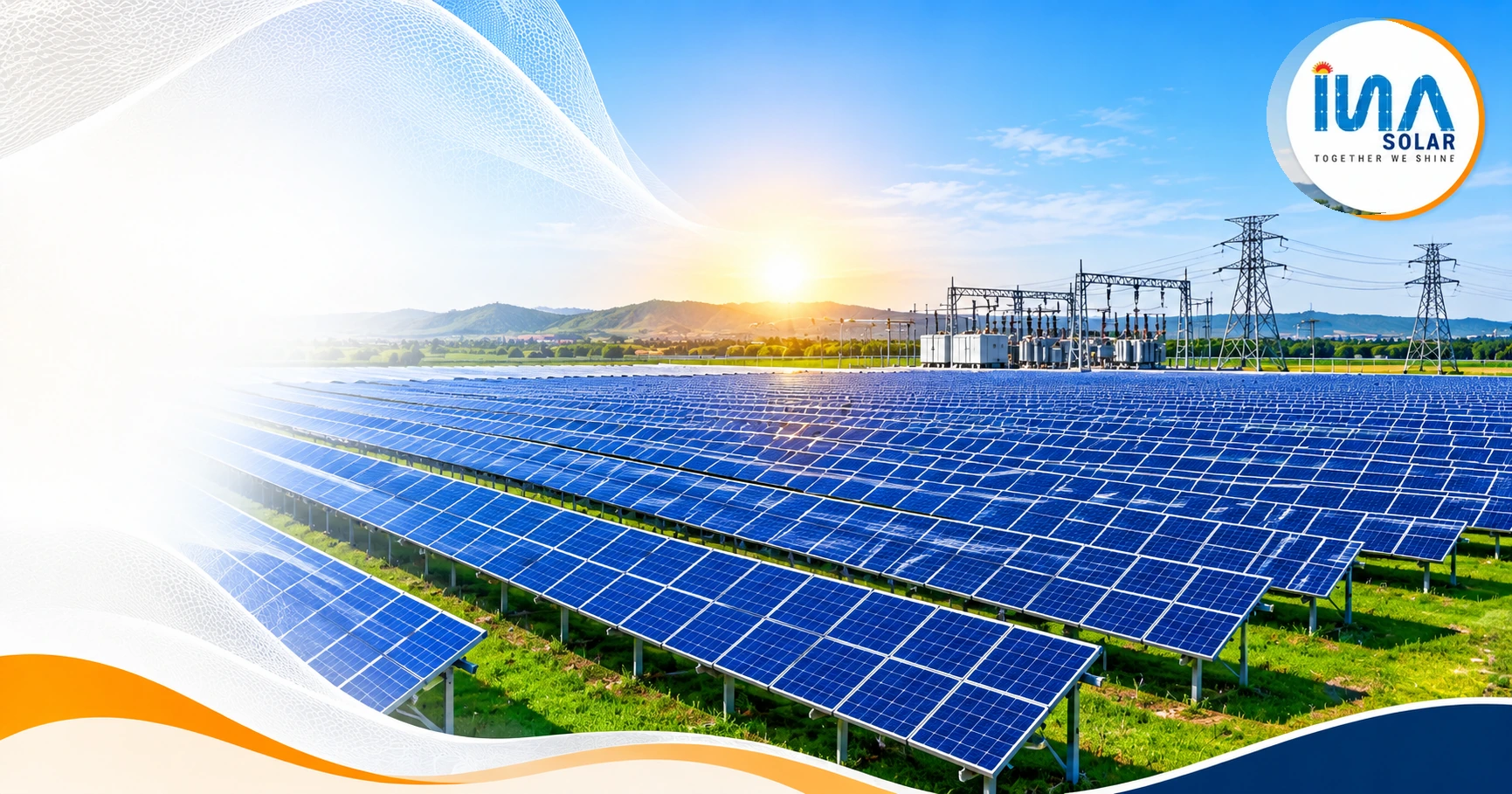
+91 7240 444 666Utility-scale solar refers to large-scale electricity generation through extensive ground-mounted solar farms comprising thousands of photovoltaic (PV) modules. Unlike a small number of solar panels on rooftops, these projects operate at the megawatt (MW) or gigawatt (GW) scale, supplying electricity to the wider grid for distribution to homes, businesses, and industries.
Their operation requires supporting infrastructure, including inverters, transformers, substations, and transmission lines to convert and deliver the generated electricity. Increasingly, these installations are also being paired with battery energy storage systems (BESS) and wind power to balance fluctuations in generation, improve grid flexibility, and ensure a more reliable renewable energy supply during periods of low solar output.
|
Feature |
Utility-Scale Solar |
Rooftop Solar |
|
Scale |
Megawatts (MW) to gigawatts (GW) |
Typically kilowatts (kW) |
|
Location |
Large ground-mounted solar farms |
Residential, commercial, and industrial rooftops |
|
Primary purpose |
Large-scale electricity generation for grid supply |
Primarily on-site electricity consumption |
|
Grid connection |
Connected through substations and transmission infrastructure |
Connected to the local distribution network |
India's solar expansion is accelerating. In FY 2025–26, the country added 44.61 GW of solar capacity, nearly double the 23.83 GW added in the previous financial year. This rapid growth reflects the increasing pace of renewable energy deployment, with large ground-mounted projects playing a major role.
As of March 31, 2026, ground-mounted solar installations accounted for approximately 110.43 GW of India's total installed solar capacity of 150.26 GW. This highlights the importance of utility-scale projects in meeting the country's growing electricity demand.
The growing number of solar projects has also increased demand for photovoltaic (PV) modules, driving a significant expansion in domestic manufacturing. India's solar module manufacturing capacity grew from just 2.3 GW in 2014 to over 172 GW as of March 31, 2026.
This expansion is particularly important for utility-scale developments, which require large volumes of modules that meet specific quality and performance standards. A stronger domestic manufacturing base is helping support project deployment while reducing dependence on imported solar equipment.
Government-backed procurement has provided another important boost to utility-scale solar. Agencies such as the Solar Energy Corporation of India (SECI) facilitate project development through tariff-based competitive bidding, allowing developers to secure long-term power purchase agreements (PPAs) with electricity procurers.
This process continues to generate opportunities for new projects. For instance, on September 3, 2026, SECI issued a tender for 700 MW of Inter-State Transmission System (ISTS)-connected solar photovoltaic projects in Special Economic Zones (SEZs) and areas designated as Export-Oriented Units (EOUs).
Such procurement initiatives help create a project pipeline and provide developers with greater visibility into future demand.
The growth of India's solar market is also reflected in INA Solar's expanding project portfolio. Through its subsidiary, Insolation Green Energy Private Limited, the company has secured several significant orders in 2026.
In July 2026, the subsidiary secured a ₹558.29 crore solar PV module supply order from NTPC Renewable Energy Limited for a utility-scale project in Lalitpur, Uttar Pradesh. The order involves M10R N-Type TOPCon dual-glass bifacial solar modules.
In August 2026, the company also received a Letter of Award (LoA) from Maharashtra State Electricity Distribution Company Limited (MSEDCL) for nine decentralised solar projects under the Mukhyamantri Saur Krushi Vahini Yojana (MSKVY) 2.0. The projects have a combined capacity of 99 MW AC (128.7 MW DC), with an estimated investment of ₹425 crore.
These developments reflect INA Solar's participation in India's expanding solar sector, spanning both module supply and project development. They also demonstrate how domestic solar manufacturers are increasingly participating in the country's transition towards large-scale renewable energy.
|
Indicator |
Latest figure |
|
Total installed solar capacity |
171.05 GW |
|
Ground-mounted solar capacity |
125.65 GW |
|
Solar capacity added in FY 2025–26 |
44.61 GW |
|
Solar module manufacturing capacity |
~172 GW |
Sources: MNRE Physical Achievements report, September 30, 2026, and MNRE FY 2025–26 statistics.
Utility-scale solar is moving beyond simply adding more panels and expanding capacity. Developers are increasingly adopting high-efficiency technologies such as Tunnel Oxide Passivated Contact (TOPCon) and bifacial modules to generate more power from available land. Battery storage is also gaining importance, allowing surplus daytime solar energy to be stored and used after sunset when generation drops but electricity demand continues.
SECI's development pipeline reflects this shift. At Ramagiri, Andhra Pradesh, a proposed 70 MW Inter-State Transmission System (ISTS)-connected solar project is being paired with a 25 MW/50 MWh Battery Energy Storage System (BESS). The wider development also includes wind power, reflecting the growing integration of multiple renewable energy sources.
The focus is shifting from simply generating more renewable electricity to making it available when the grid needs it.
Utility-scale solar projects face challenges ranging from land acquisition to long-term operations. Securing suitable land can be time-consuming, while limited transmission infrastructure can delay the evacuation of generated electricity.
Solar generation also fluctuates with sunlight, making battery storage important for meeting demand after sunset. Additionally, plants require regular maintenance and monitoring to sustain performance over their operational life.
Ultimately, generating electricity is only half the challenge; it must also be efficiently stored, transmitted, and delivered when needed.
|
Factor |
Why It Matters |
|
Module technology |
Higher efficiency and better energy yield |
|
Manufacturing capacity |
Ability to meet large-volume requirements |
|
Quality and certifications |
Product reliability and long-term performance |
|
EPC capabilities |
Efficient project execution and commissioning |
|
O&M support |
Consistent plant performance over time |
|
Supply-chain strength |
Timely procurement and project delivery |
India’s utility-scale solar growth is driven by rising electricity demand and the need to expand renewable energy capacity. The focus now is on improving project efficiency, strengthening grid connectivity, and ensuring reliable power delivery.
Insolation Energy is expanding its presence across this sector with 5.5 GW of solar module manufacturing capacity in Jaipur, alongside ongoing expansions in solar cell (4.5 GW) and aluminium frame (18,000 MTA) manufacturing. Its portfolio includes 500–635 Wp TOPCon and Mono PERC modules, over 400 MW of IPP projects, 1,000+ channel partners, and a presence across 250+ districts. Its ₹558.29 crore module supply order from NTPC Renewable Energy in July 2026 further highlights its participation in India’s utility-scale solar market.

INA SOLAR AT REI EXPO 2026: DRIVING SOLAR INNOVATION. BUILDING FOR THE FUTURE.


INA Solar at REI Expo 2026: Discover Advanced Solar Manufacturing and Next-Generation TOPCon Modules
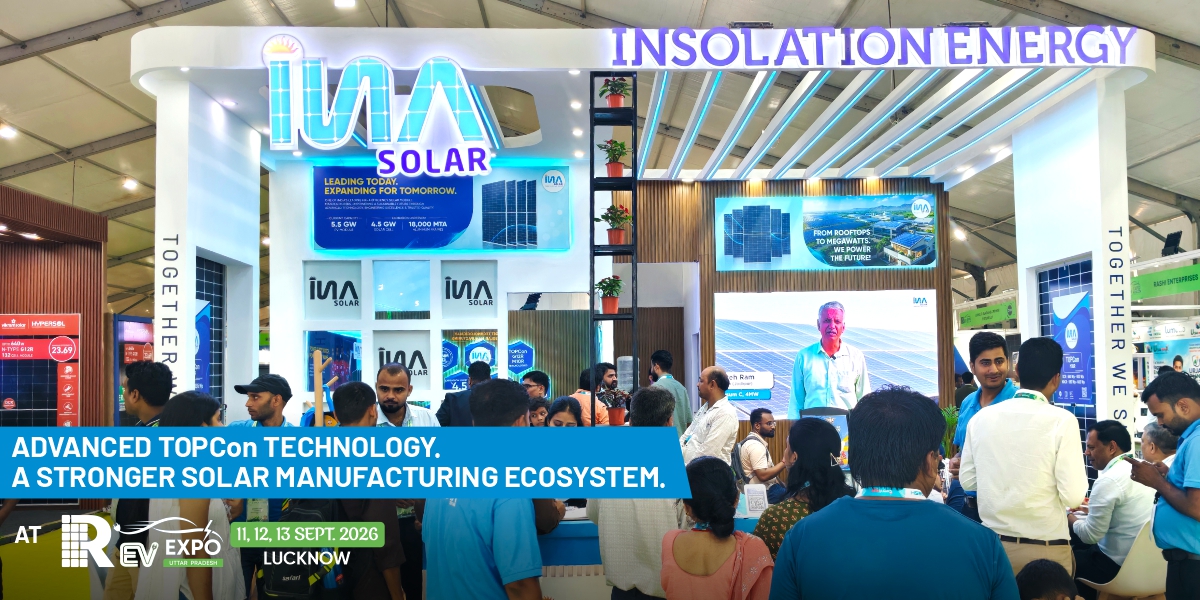
From G12R TOPCon Technology to a Growing Solar Manufacturing Ecosystem


For Sales Enquiries

Email Address