Sales Enquiries
+91 7240 444 666Sales Enquiries
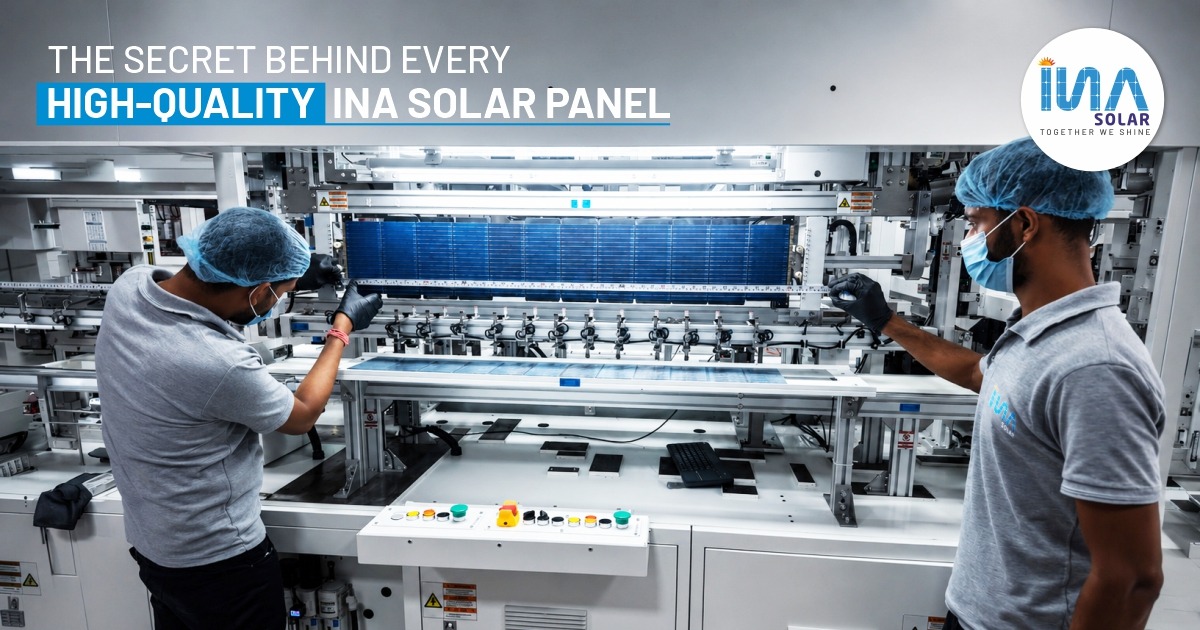
+91 7240 444 666For a channel partner, the hardest part of scaling isn't winning more orders. It's making sure order number 500 performs exactly like order number 5. One inconsistent batch can undo months of trust built with a customer, and the partner is the one standing in front of that customer, not the factory. This is the gap INA Solar is built to close. As one of India's leading solar panel manufacturers, we've structured our manufacturing so that quality isn't a promise made once during a sales pitch. It's a standard repeated at every facility, on every line, for every order, however large.
INA Solar runs three advanced manufacturing facilities in Jaipur with a combined annual capacity of 5.5 GW, and a fourth is already on the way. Rather than treating each facility as an independent unit, we run them on one unified manufacturing standard. The same testing protocols, the same quality checkpoints, the same production discipline, whether a panel comes off Line 1, Line 2 or Line 3. For partners, an order split across facilities to meet a tight deadline never means a split in quality. What reaches the customer's rooftop is the same INA Solar panel, every time.
How Insolation Green Energy's Manufacturing Quality Plan compares against the baselines the solar industry commonly works to
|
AQL1 Major-defect sampling threshold — strict end of the 1.0–1.5 range ISO 2859-1 treats as normal |
4x Separate EL imaging checkpoints per module across the line, not just one at the end |
100% Of modules Hi-Pot electrical-safety tested, every shift, on the same IEC clauses used for design certification |
|
+1Wp only Flash-test calibration tolerance — negative tolerance not allowed, so power isn't over-rated |
31 Raw-material line items under formal incoming inspection: 13 core BOM, 9 consumables, 9 packing |
20+ Government and PSU buyers on the customer list, each requiring a qualified, audited supplier |
A solar module's quality is decided long before it reaches a rooftop or a substation — it is decided in the sequence of checks a manufacturer chooses to run, and how often it runs them. INA Solar documents that sequence in unusual detail in its internal Manufacturing Quality Plan (Doc. No. IGEPL/QA/CP/01). Here's what stands out, point by point.
Nothing gets past incoming inspection without a fight.
The " boring" stuff gets checked too.
Most factories check the start and the finish. INA checks the middle too.
Most factories run the full IEC test suite once, to get certified. INA runs it every shift.
A quality system is only as convincing as the outside scrutiny it has survived.
|
Control Point |
INA Specification |
Frequency / Sampling |
|
Incoming major-defect characteristics – cells, encapsulant, backsheet, ribbon, sealant, flux |
AQL1 |
Per lot, Special Inspection sampling |
|
Ribbon / frame / junction box identity (make & type vs. BOM) |
Critical classification (AQL1 – ribbon; AQL2.5 – frame & junction box) |
Per lot, Special Inspection sampling |
|
Consumables – RFID tag, soldering flux |
AQL1 |
Per lot, Special Inspection sampling |
|
Packing materials – wooden pallet, packing boxes |
AQL2.5 |
Per lot, Special Inspection-1 |
|
Stringer soldering peel strength |
1 N/mm (ribbon diameter) |
Every stringer, both sides, every shift |
|
Auto-bussing ribbon-to-busbar peel strength |
≥ 1 N/mm |
Every shift, all stations |
|
Laminator gel content |
EVA 75–95% / EPE-POE 65–95% |
Weekly, every laminator |
|
Laminator peel adhesion |
≥ 60 N/cm (glass), ≥ 40 N/cm (backsheet) |
Weekly, every laminator |
|
Frame anodizing coating thickness |
≥ 15 micron |
3 pcs, every shift |
|
Hi-Pot insulation resistance |
Per IEC 61215-1:2016, clause MQT03 |
100%, 4 pcs, continuous every shift |
|
Hi-Pot ground continuity |
Per IEC 61730-2:2016, clause MST13 |
100%, 4 pcs, continuous every shift |
|
Final EL imaging & visual inspection |
Per EL / visual inspection criteria |
100%, 4 pcs, continuous every shift |
Electroluminescence imaging is the closest thing the industry has to an X-ray for a solar module. Current is pushed through the panel and a camera captures the cells glowing, which makes microcracks, broken fingers and dead cells visible long before they'd ever show up on a rooftop. Plenty of manufacturers EL test a sample from each batch.
We EL test 100% of panels. Every module, every line, every shift. Our first pass yield sits at 98%, which means 98 out of every 100 panels clear the full inspection chain the first time through, and the remaining two are caught inside the factory rather than at a customer's site. That number is the whole argument for consistency, stated plainly.
Our in-house reliability lab is IEC standard compatible and runs a qualification programme of 17 tests. These aren't quick checks. Damp heat alone occupies a chamber for 1,000 hours at 85 degrees Celsius and 85% relative humidity, which is 42 straight days of accelerated tropical monsoon.
Salt mist and the 5,400 Pa snow load matter more than most partners realise. They're the two tests that decide whether you can quote confidently for a coastal installation in Gujarat or a rooftop in the Himalayan belt without adding a mental asterisk.
Every INA Solar module carries a QR code linked to our ERP and NAS systems. Scan it and the panel's manufacturing record comes up: the batch, the line, the material used. If a partner ever needs to trace a specific module from a specific consignment, the answer exists and it's retrievable. This is what turns one manufacturing standard from a claim into something you can audit.
Consistency at scale is hard to reach through manual processes alone, which is why our facilities lean on AI driven monitoring and robotics at critical stages of production. Automated systems catch micro defects that are easy to miss at a glance, and robotic precision keeps cell placement, lamination and frame assembly uniform across thousands of panels a day. This isn't about replacing craftsmanship. It's about making sure the craftsmanship holds up identically at unit one and unit ten thousand.
Every TOPCon and Mono PERC module coming out of INA Solar is ALMM List-I approved, so partners can offer panels for government linked and subsidy schemes without worrying about eligibility gaps. Each module carries a 30-year performance warranty and a 12-year product warranty. For a partner explaining warranty terms to a customer, that's a conversation backed by paperwork rather than assurance.
Our manufacturing footprint gives us flexibility without compromise. A small residential order, a housing society order, an IPP scale project: the same production standard applies to all three. INA Solar has already delivered 100+ MW of IPP project capacity, which is proof that quality control holds at utility scale and not only in smaller rooftop batches. As we expand toward 4.5 GW of solar cell manufacturing and 18,000 MTA of aluminium frame production at our upcoming Narmadapuram unit in Madhya Pradesh, the same one standard approach scales with the capacity.
As a channel partner, your reputation rides on every panel you sell, not just the first one. When quality is consistent across every facility and every order, you spend less time managing complaints and more time closing the next sale. You can quote confidently on large orders without worrying that scale will cost you the standard. With 40,000+ customers and 1,000+ channel partners across 100+ districts already backing that trust, INA Solar's three facility standard is one more reason partners keep choosing us as they grow. Together We Shine, consistently, at every scale.
INA Solar operates three manufacturing facilities in Jaipur, Rajasthan, with a combined annual capacity of 5.5 GW, and a fourth facility is already underway.
All facilities follow the same manufacturing standard, testing protocols and quality checkpoints, supported by AI driven monitoring and robotics. Quality is verified at every stage rather than only at final inspection, with close to 25% of our manpower dedicated to the Quality and Engineering department, a full set of reliability measuring instruments, and an IEC standard compatible in-house lab. A dedicated budget is allocated to upskilling that team. INA is also pursuing manufacturing excellence through a focused PQCDSME approach covering productivity, quality, cost, delivery, safety, morale and environment.
Every panel is electroluminescence tested. EL imaging runs on 100% of modules, not on a sample basis, which is how microcracks and cell defects are caught before a panel leaves the factory. Our first pass yield is 98%.
Our in-house lab runs 17 qualification tests, including 1,000 hours of damp heat at 85 C and 85% RH, 96 hours of PID testing at 1,500 V, 576 hours of Severity 4 salt mist, thermal cycling between minus 40 C and plus 85 C, hail impact up to 75 mm, and mechanical load testing at 2,400 Pa with snow load taken to 5,400 Pa. Panels are also checked for wet leakage, UV exposure, LETID, bypass diode function and junction box strength.
Incoming material is inspected under an ISO 2859-1:1999 based sampling plan covering 13 material categories, from solar cells and glass to junction boxes and packaging. Critical materials are inspected at AQL 1. Every lot is dispositioned as OK, Hold or Reject in ERP, and any material that could affect module reliability is rejected and moved to block stock with a supplier SCAR raised under the 8D method.
Yes. Every module carries a QR code linked to our ERP and NAS systems, which stores the panel's batch, line and material record. Partners can trace any individual module back to how and when it was made.
Yes. INA Solar's TOPCon and Mono PERC modules are ALMM List-I approved, making them eligible for government linked and subsidy schemes including PM Surya Ghar.
Every INA Solar module carries a 30-year performance warranty and a 12-year product warranty, applicable regardless of which facility it was manufactured at.
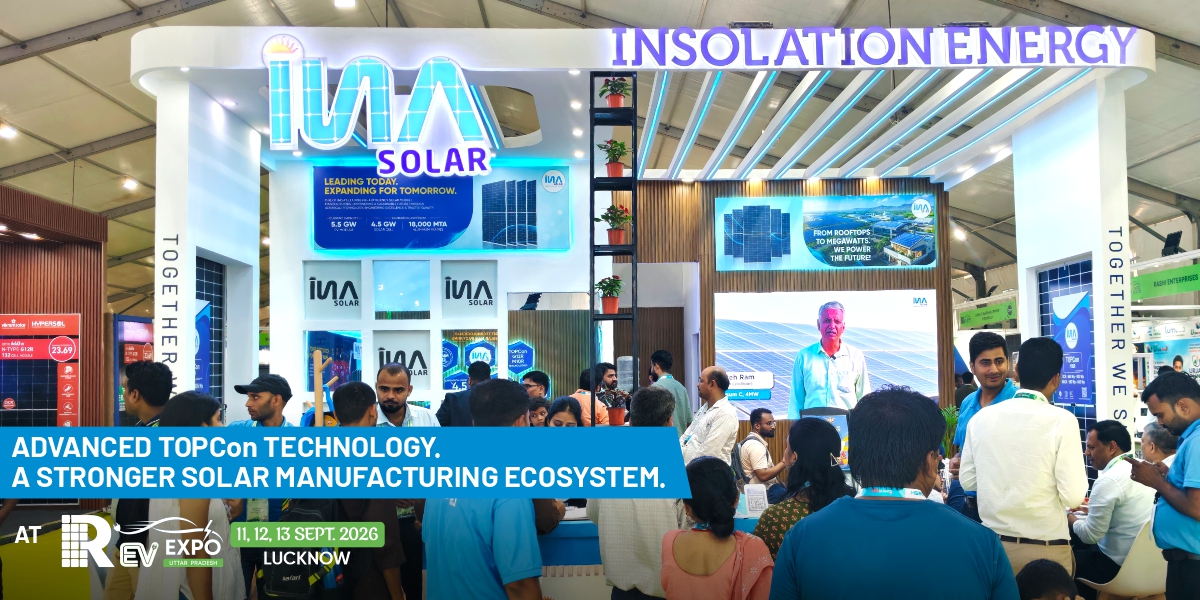
From G12R TOPCon Technology to a Growing Solar Manufacturing Ecosystem


Solar for the Textile Industry: How It Cuts Energy Costs and Improves ROI
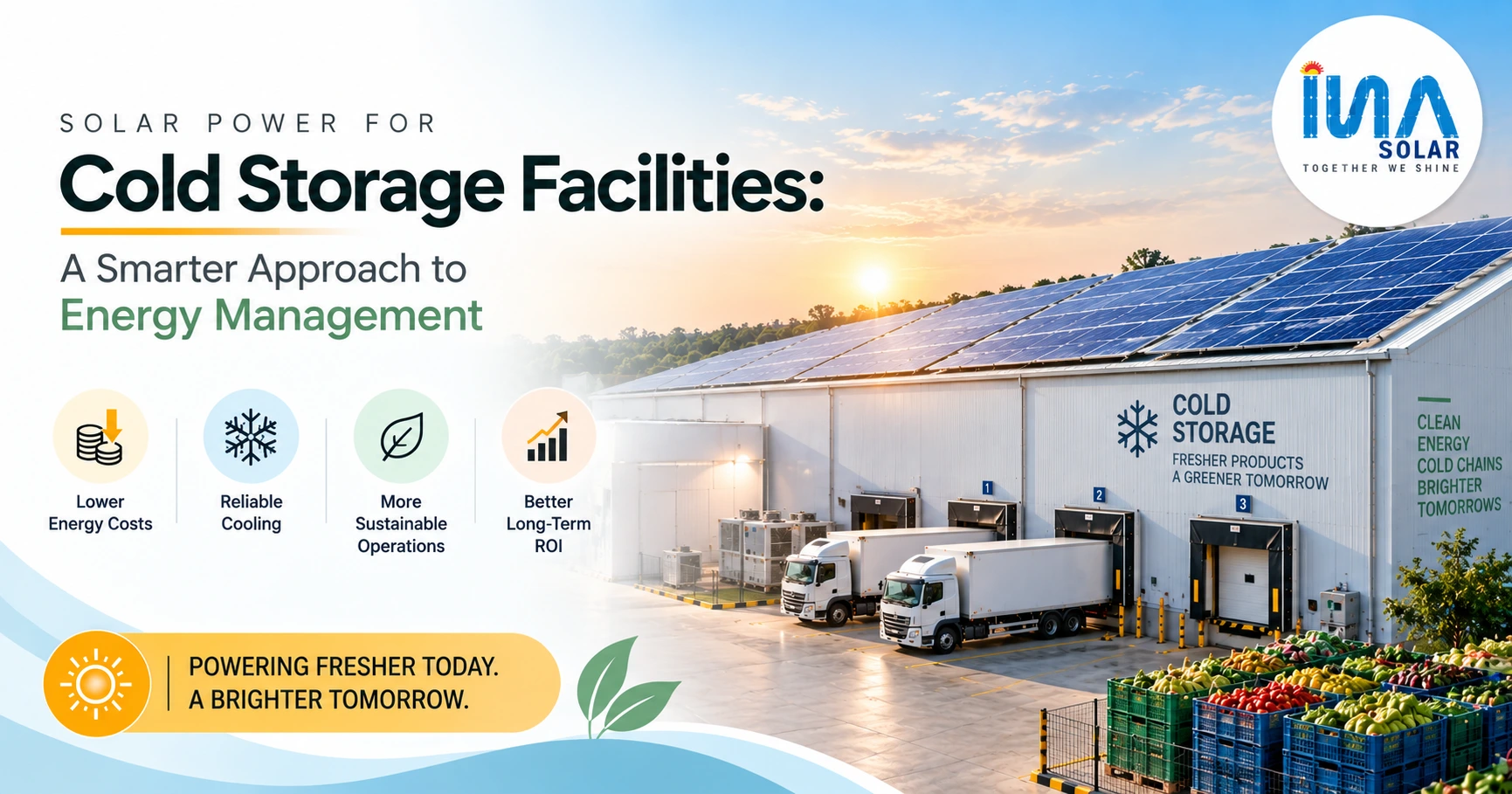
Solar Power for Cold Storage Facilities: A Smarter Approach to Energy Management


For Sales Enquiries

Email Address