Sales Enquiries
+91 7240 444 666Sales Enquiries
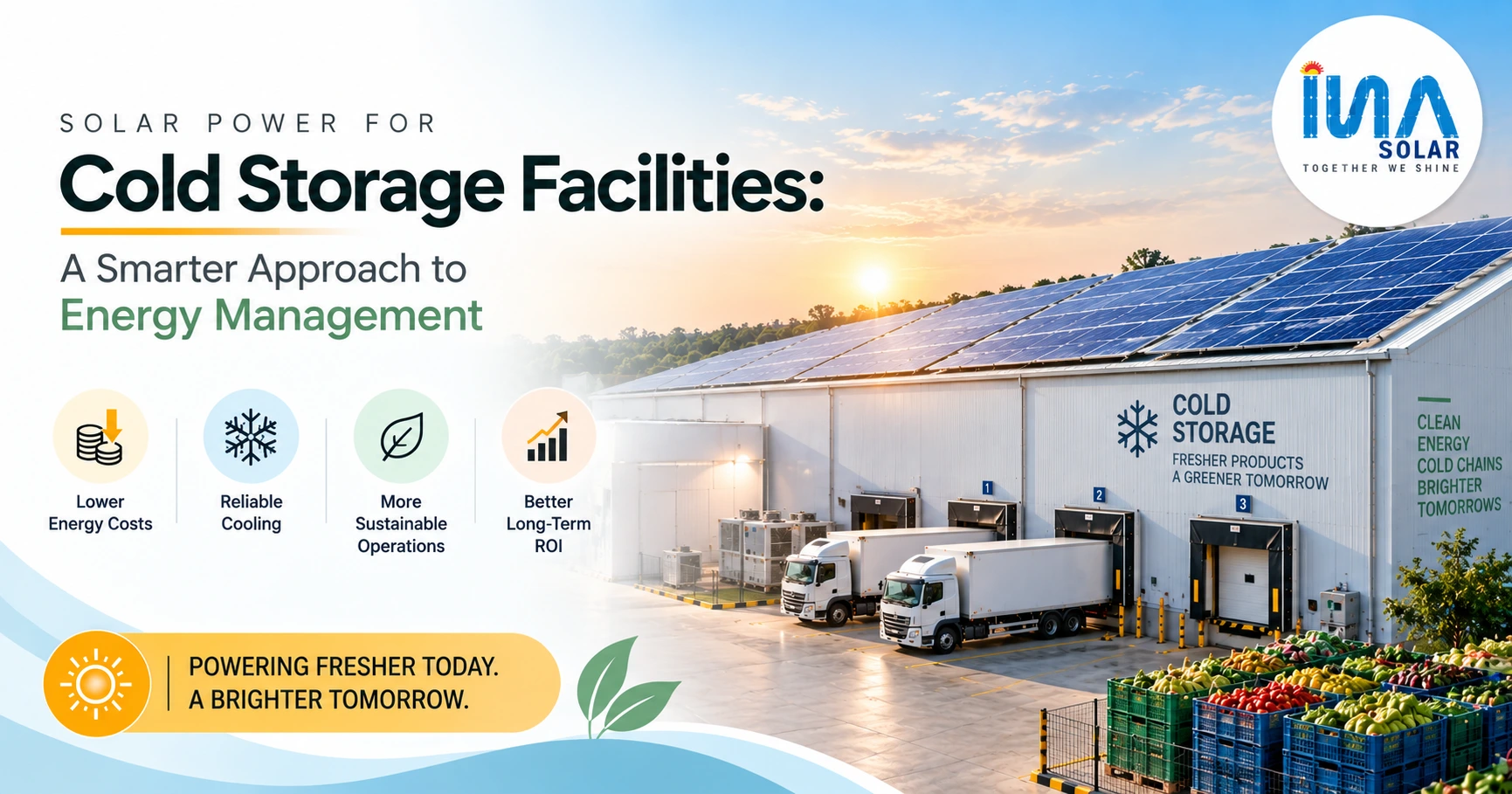
+91 7240 444 666Cold storage units require a stable and continuous power source to sustain the temperatures needed for perishable and temperature-sensitive products. Refrigeration is not like many other operations where you just shut it down when things slow down. Compressors, evaporators, fans, pumps, and control systems still need electricity, which can become a significant running cost over time.
In this sense, for cold storage operators, energy consumption control is a major operational issue. Many of them are looking for solutions to lessen their dependence on grid electricity and obtain more control over long-term energy costs. One such alternative is solar power, which allows facilities to generate some of their electricity on-site and use it for day-to-day operations, especially when demand is high throughout the day.
It is worth examining the scale of this need. The National Centre for Cold-chain Development (NCCD) estimates that the energy consumption of bulk cold-storage facilities over 20 years old was around 1,700 GWh in 2024.
Source:
Author/Organisation Name: National Centre for Cold-chain Development (NCCD).
Title of Source: Energy Transition in Cold Chain Infrastructure.
Year of Source: 2025.
Link to the Source:
https://nccd.gov.in/uploads/ET_in_cold_chain_sector_in_India_v8_3bfe3b8148.pdf
Energy can become one of the major running expenditures in a cold storage facility. The answer is actually rather simple: maintaining things at a specified temperature requires a consistent source of power. Compressors, condensers, evaporators, fans, and pumps provide a lot of the heavy lifting, and lighting, ventilation, temperature controls, and material handling equipment contribute to the overall consumption.
But each facility does not have the same criteria. A store with frozen products may require more refrigeration than a store with chilled products, and larger stores will have a heavier load only because they are larger. Insulation, refrigeration equipment, external temperature and even the frequency of commodities moving in and out might affect demand. This is why the cold-storage operator must determine where and when electricity is being used before calculating how much solar capacity the facility actually needs.
Electricity consumption of cold storage facilities is also high, and solar power may be a viable solution to lessen dependency on the grid. Good design can be integrated into the facility’s current electrical system without impacting refrigeration function. The panels create electricity that is channeled through an inverter and directed to the facility as needed.
Depending on the system design and the energy needs of the facility, this power can be used to run refrigeration equipment and meet other operational demands, thereby offsetting some of the electricity that would otherwise be supplied from the grid.
For a cold-storage facility that consumes a lot of power during the day, an on-grid system makes sense, as solar energy may be consumed as it is created. The hybrid system takes it a step farther. It integrates solar and grid power with battery storage. That greater flexibility might be a valuable feature in places where reliable power is a top concern.
If the grid connection is inadequate or non-existent, an off-grid system can be explored, but this requires significant battery capacity and careful sizing of the system. In practice, the choice is a function of the power demand of the facility, location, and reliability demands.
Installing solar at a cold storage facility is not simply a matter of covering the available roof space with panels. The system needs to be planned around the facility's actual energy requirements and operating conditions. The first step is to look at prior electricity bills to assess the refrigeration load, compressor capacity, operating hours and seasonal changes.
The roof itself also has to be correctly assessed. Size, condition, shading, orientation and structural strength can affect the installation. It will therefore be a question of the facility’s power requirements, whether an on-grid, hybrid or off-grid solution is more appropriate. Reliability also needs some thought as a power outage can put temperature-sensitive merchandise at risk.
Finally, the operator should consider the system cost, projected solar generation, electricity tariff, maintenance and other costs as applicable. These characteristics vary from facility to facility. So, there is no acceptable one-size-fits-all value for solar payback or ROI.
When choosing a solar solution for a cold storage facility, it is more than simply selecting the module with the highest power rating. The system should match how the facility uses power, the space available for installation, and the performance expected over time. After all, the constant demand for power refrigeration means that the selection of modules has to be sensible in relation to the actual running needs of the facility.
In this context, INA Solar provides TOPCon and Mono PERC modules from 500 Wp to 635 Wp for companies to choose from according to their project requirements and available installation space. Its modules are also supported by certifications and standards such as BIS, IEC, ISO, UL, CE and ALMM.
The first step for cold storage operators is to establish what their energy requirement is and then to select a system that is appropriate. INA Solar’s product line has applicable solutions for companies that want to offset some of their daytime power use and plan for their longer-term energy demands.
From G12R TOPCon Technology to a Growing Solar Manufacturing Ecosystem

Solar for the Textile Industry: How It Cuts Energy Costs and Improves ROI

PM JANMAN Yojana: How India Is Bringing Solar Power to Its Most Vulnerable Tribal Communities


For Sales Enquiries

Email Address